AI · · 5 min read
A bilingual news archive updated by a weekly AI agent
How Venezuela Record keeps a bilingual, chronological news archive current with a scheduled AI agent and human review of doubtful items.
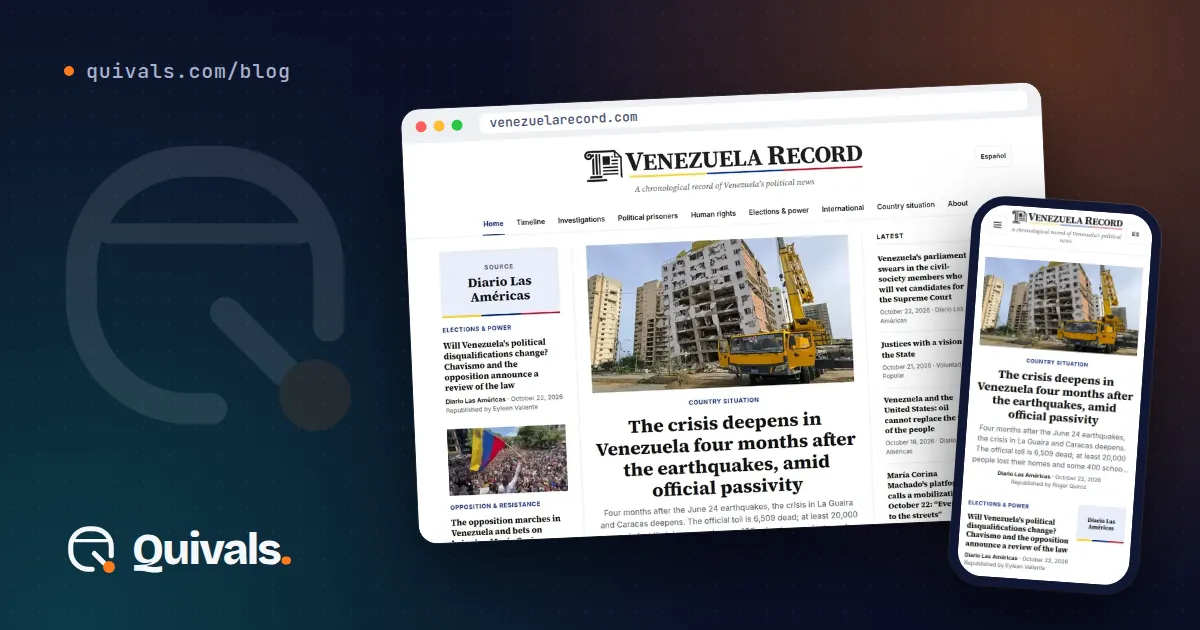
Some websites are never finished. A news archive, a product catalog, a list of events or a directory only stays useful if someone keeps adding to it. In most small organizations that someone is one busy person, and the updates slip.
This is how we built Venezuela Record, a bilingual, chronological archive of political news about Venezuela, and how a scheduled AI agent keeps it current every week while people still make the calls that need judgment.
The problem: scattered news, hard to follow over time
Political news about Venezuela is spread across many outlets. Following a story over months means jumping between sites, and much of the coverage exists only in Spanish. An English-speaking reader has a hard time seeing the whole picture.
The goal was a single place that puts the news in order by the date it was originally published, in English and Spanish, with full credit to the outlet that reported it. The archive had to grow every week without turning into a second job.
What we built
A static site, in two languages. The site is built with Astro as static pages on Cloudflare Pages. English lives at / and Spanish at /es/. A small function reads each visitor’s browser language and shows the matching version, and a link in the header lets people switch.
Every story in both languages, or it doesn’t publish. We made a rule the build enforces: if a story exists in one language but not the other, the build fails and nothing goes live. It sounds strict. It’s the only reliable way to keep two versions of a site from drifting apart over time.
Chronological by original date. Stories are sorted by when the outlet first published them, not by when we added them. That keeps the timeline honest even when an older story is added later. Today the archive covers stories originally dated from January 9, 2025 to October 22, 2026.
Editorial rules written into the code. Credit isn’t left to memory. Every story carries the author, the outlet, the original date and a link. For outlets without a republishing agreement, the site shows only the headline and our own summary of 60 words or fewer, with a link to the full story. Agency photos aren’t used. Because these rules live in the code, the agent can’t skip them, and neither can a person in a hurry.
The weekly agent
Every Thursday at 8:00 a.m. Pacific time, a scheduled agent runs. Here’s what it does:
- It searches for the week’s news that falls within the archive’s scope.
- It adds each story in both languages, following the editorial rules.
- It runs the site build to check that everything is valid, including the two-language rule.
- It publishes the stories that pass.
- Anything it isn’t sure about is set aside as “pending your decision” for a person to review.
That last step is the most important design decision in the project.
Why the agent doesn’t decide everything
An agent can apply fixed criteria quickly and consistently. It’s good at the repetitive part: finding candidate stories, formatting them, writing both versions, checking the build.
It’s not the right tool for borderline calls. Is this story really within scope? Is this outlet one we should cite? When a story is doubtful, the agent stops and leaves it for a human. We’d rather have a short list to review every week than an archive that slowly fills with items nobody would have chosen.
This is also why we don’t describe the archive as “verified news”. The accurate description is that the agent applies fixed criteria and doubtful items get human review. Claiming more than the system does is a risk, and it’s an easy one to avoid.
What can be measured
We keep the numbers to what the live site shows:
- 190 URLs in the live sitemap as of October 26, 2026.
- 138 stories: 69 in English and 69 in Spanish, one pair for each story.
- 6 investigation pages.
- New stories every Thursday, added by the weekly agent.
We don’t report traffic or readership here. The point of this post is the method: how a small team keeps a growing, bilingual site accurate without a full-time editor.
Trade-offs we accepted
- Static pages over a database. A static site is fast, cheap to host and hard to break. The trade-off is that every update means a new build. With a scheduled agent doing the build, that cost disappears.
- Strict build rules. A failed build is annoying in the moment. It’s much better than discovering months later that half the Spanish stories are missing.
- A human in the loop. The agent could publish everything. We chose to have it publish only what passes clear rules and hold the rest. The weekly review takes minutes, and it keeps the archive trustworthy.
What this means for your business
You may not run a news archive, but you probably have content that needs regular updates: a menu, a product list, event dates, service areas, a resource page. The same approach works:
- Write your rules down first. What belongs on the page, how it should be credited or formatted, what’s out of scope. An agent can only follow rules that exist.
- Put the rules in the system, not in someone’s head. Checks that run on every update catch mistakes no matter who, or what, made the change.
- Automate the repetitive part. Searching, formatting, translating and checking are good jobs for a scheduled agent.
- Keep people on the judgment calls. Have the agent flag anything doubtful instead of guessing. A short weekly review list is a feature, not a failure.
- Make bilingual content a rule, not a hope. If you serve customers in two languages, set up your site so one version can’t go live without the other.
- Describe it honestly. Say what the system really does. Your readers and customers will trust you more for it.
Where to start
Pick one page on your site that’s always out of date. Write down what a correct update looks like and who should approve the unclear cases. That’s the brief for an agent.
You can read the short version of this project in our work, and see how we build agents like this on our AI development and process automation pages.
Have content that never stays current? WhatsApp or text us at (805) 750-3255, or use the contact form.